Skip to main navigation menu Skip to main content Skip to site footer

Volume 1, No. 17jul-dez 2025

Published 27 March 2026

Articles

  1. A Política Externa Cazaque nos Governos Nazarbayev e Tokayev (1991-presente): Autonomia via Third Neighbour ou Balança de Poder?

    Servindo de passagem para fluxos energéticos por intermédio de gasodutos, oleodutos e rotas comerciais entre duas das principais potências do sistema mundial contemporâneo, China e Rússia, o Cazaquistão é um país que possui sua política externa estimulada pela influência de Moscou e Pequim no espaço pós-soviético. Entretanto, Astana busca, progressivamente, expandir seus laços político-diplomáticos para além deste eixo, através das suas reservas energéticas. Uma estratégia autônoma que combina comportamentos de balanceamento em seu exterior próximo. Não obstante, por mais que os governos cazaques tenham obtido sucesso em aumentar sua participação nas dinâmicas regionais e, em certa medida, na política global de maneira pragmática, o país ainda sustenta forte ligação com as tradicionais potências vizinhas. Em outras palavras, pode-se considerar que, caso o Cazaquistão não consiga manter o equilíbrio na balança de poder entre Rússia e China, sua tentativa de explorar relações paralelas ao foco sino-russo poderá não obter êxito. Nesse sentido, o presente estudo explora os elementos históricos da política externa cazaque durante os governos de Nursultan Nazarbayev e Kassym-Jomart Tokayev a partir do seu entorno estratégico e seus impactos na articulação de táticas contemporâneas. De forma semelhante, infere-se que, mesmo sendo uma nação que busca por autonomia no Sistema Internacional, a concorrência exterior ainda exerce significativa interferência nas diretrizes de seu comportamento externo

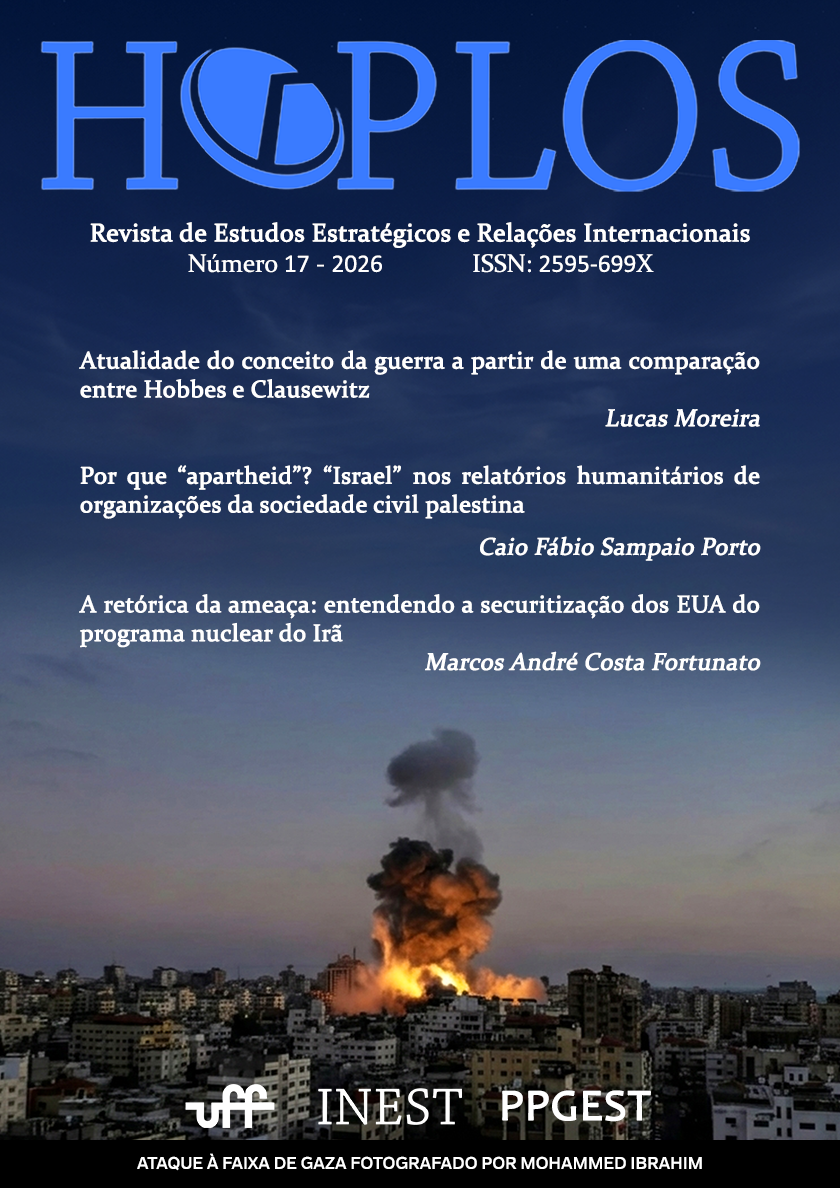
  2. A atualidade do conceito da guerra a partir de uma comparação entre Hobbes e Clausewitz

    This article conducts a literature review to compare and investigate the contemporary relevance of the conceptions of war held by Thomas Hobbes and Carl von Clausewitz, two key theorists in the study of war. Hobbes understood war as an inherent condition of the state of nature, characterized by fear and insecurity, with the State being the only solution to avert widespread conflict. In contrast, Clausewitz defined war as a bloody duel, a continuation of politics by other means, attributing to it a strategic and instrumental character within interstate relations. With the emergence of new forms of conflict, the pertinence of these classical conceptions is called into question. The study demonstrates that, despite changes in the contemporary warfare landscape, both approaches remain relevant, though they require adaptations to encompass current technological and geopolitical transformations. In this way, the work seeks to contribute to the debate on the evolution of the concept of war by adapting classical theories to the technological and geopolitical transformations of the 21st century, offering new perspectives on modern conflicts.

  3. Por que “Apartheid”? “Israel” nos relatórios humanitários de Organizações da Sociedade Civil palestina

    This paper explores the use of the "Apartheid framework" (AFW) by Palestinian activists and civil society organizations (CSOs) to, based on Israeli discriminatory policies, frame and theorize it as an Apartheid. Drawing on reports by Palestinian CSOs such as Al-Haq, this paper discusses how the AFW transcends the accusation of Apartheid by providing an analysis that links physical, structural, and epistemic violence within the context of a Zionist necrobiopolitics. In dialogue with theories of power and transnational advocacy networks, I examine the AFW as a tool for resistance and international engagement with the Palestinian cause. Sociological analysis of the AFW as a tool for pro-Palestinian knowledge-making and advocacy is essential to understanding both the practices underpinning Israeli Apartheid and how pro-Palestinian movements work to foster solidarity. Furthermore, this study underscores the framework’s capacity to reveal underlying systems of oppression and to stimulate robust global debate on justice and human rights.

  4. THE INFLUENCE OF CULTURES ON INTERNATIONAL NEGOTIATIONS

    Culture is a pervasive influence in international negotiations, with anthropology playing a key role in navigating the complexities behind it. As the world becomes increasingly globalized, international negotiations cannot be properly conducted without understanding the cultural nuances that underpin the practices and expectations of negotiators. However, the complexity of these negotiations goes beyond mere commercial or diplomatic transactions, and is influenced by the cultural diversity of those involved. Anthropology offers a valuable lens through which to examine the cultural complexities that underlie international negotiations. By analyzing the beliefs, values, norms, and social practices of different human groups, anthropology reveals how these elements shape the approaches and expectations of negotiators in global contexts. By recognizing and integrating an anthropological approach to international negotiations, negotiators can bridge cultural divides, fostering greater mutual understanding and global collaboration. This article seeks to highlight the importance of deep cultural sensitivity and constant adaptation to cultural diversities as essential components for success in international negotiations in an increasingly interconnected and multicultural world.

  5. A Retórica da Ameaça: Entendendo a Securitização dos EUA do Programa Nuclear do Irã

    This article examines how the Iranian nuclear program was discursively constructed as a security threat by the George W. Bush administration, within the theoretical framework of the Copenhagen School. The study contextualizes the historical rivalry between Iran and the United States and highlights the geopolitical significance of Iran’s nuclear development after the Cold War, particularly regarding regional power balances and global nonproliferation debates. Through a critical discourse analysis of presidential speeches, it identifies how narratives — such as the “axis of evil” and catastrophic imagery — were deliberately employed to justify exceptional measures, including economic sanctions, diplomatic marginalization, and political isolation. The article argues that by portraying the nuclear program as a threat to international order and stability, the U.S. shifted the issue from the political to the security realm, thereby altering both public and institutional perceptions of Iran. It concludes that this securitizing rhetoric supported practices of containment, legitimized unilateral actions, and demonstrated the strategic function of political language in shaping security policymaking and sustaining hegemonic influence

  6. Crise do capital,ascensão neofascista e as novas modalidades de guerra

    Historically, war, capital and the State represented a symbiotic relationship of codependency and mutual reinforcement, determining the forms of governmentality and productive relations responsible for structuring the modern capitalist system. This article analyzes how, over the last few years, the growing process of pauperization of the masses has resulted in growing crises of legitimacy, promoting power vacuums to which new sociopolitical forces react, through the rise of radicalized far-right groups. Using the theory of securitization, we investigate how, in order to maintain the system's accumulation bases and as a way of establishing their power projects, such groups operate according to a dichotomous logic of social division, determining specific segments as responsible for the assumed decadence of the collective. To them, a logic of civil wars is employed, faced with a constructed perception of existential threat, making the mobilization of anger arising from popular dissatisfaction a mechanism for legitimizing the raising of extraordinary forces, allowing both symbolic and institutional processes of social division and gradual deterioration of democratic safeguard mechanisms