Skip to main navigation menu Skip to main content Skip to site footer

Hoplos - Journal of Strategic Studies and International Relations

About

Hoplos is the journal of the Postgraduate Program in Strategic Defense and Security Studies (PPGEST) linked to the Institute of Strategic Studies (INEST) at the Fluminense Federal University (UFF). Published twice a year, it is a pluralistic space for analysis and discussion on topics related to Strategic Studies, International Relations, and Political Science. Receiving contributions on a rolling basis, the journal publishes academic articles and reviews of recently published works, with the main objective of disseminating the work of graduate students and researchers in these areas. Submitted texts are analyzed through a blind review system and published upon recommendation by the Editorial Board.

Open Access Policy

This journal offers immediate open access to its content, following the principle that making scientific knowledge freely available to the public promotes greater global democratization of knowledge.

We emphasize that there are NO FEES for processing and submitting articles. The entire submission, evaluation, and editing process is FREE.

Meaning

Hoplos derives from hoplon (ὅπλον, plural hopla ὅπλα), which were the shields used by soldiers who would become known as hoplites (from the Greek ὁ πλίτης hoplitēs; pl. ὁ πλῖται hoplitai). Hoplites were citizen-soldiers—usually non-professionals—in the infantry of ancient Greek city-states, who adopted a formation known as the “phalanx” in combat, which was more effective in war when outnumbered. Thus, in honoring the hoplites and the hoplon, we highlight the choice of a weapon that represents protection, defense, and safety in combat, rather than a weapon of aggression. Just as this weapon defined the combatant who used it, Hoplos was created to serve as a new space for the defense of critical thinking and for the dissemination of the diverse and multifaceted debates that have been taking place in the field of Strategic Studies and its main related areas, Political Science and International Relations.

ISSN: 2595-699X

image: stockcake


Read More

Announcements

  • 2026-09-08

    Hoplos Journal Now Operates under a Continuous Publication Model

    Hoplos Journal is pleased to announce the adoption of a continuous publication model. Under this system, accepted articles will be published individually as soon as all stages of the editorial process have been completed, without having to await the completion of a full issue.


  • 2026-03-19

    Hoplos ranked as B1 by CAPES

    Hoplos has been reclassified by CAPES as a B1 journal, an achievement that acknowledges the sustained efforts of its editorial team to enhance the publication’s academic quality and expand its international reach and visibility.

Current Issue

Volume 1, No. 18Edição regular 2026.2

Published 4 September 2026

Articles

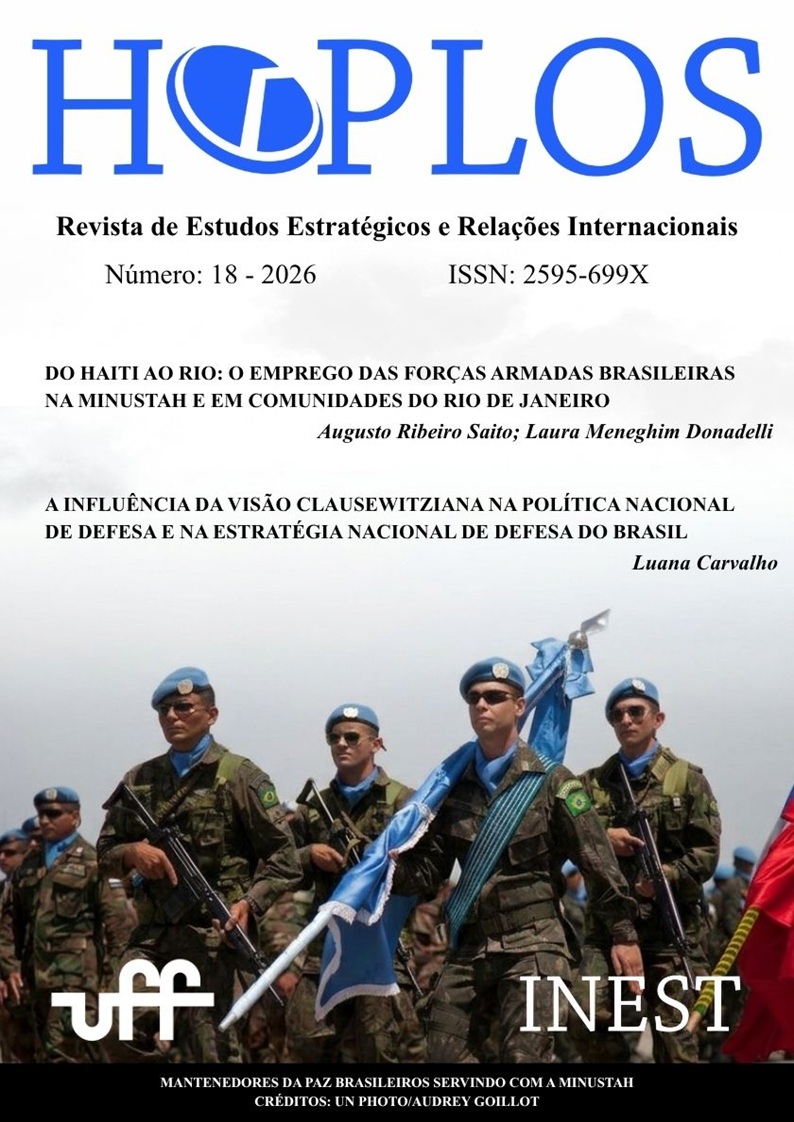
  1. From Haiti to Rio: The Deployment of the Brazilian Armed Forces in Minustah and in Rio de Janeiro’s Communities

    This paper analyzes the role of the Brazilian Armed Forces in the military command of the United Nations Mission for the Stabilization of Haiti (MINUSTAH), between 2004 and 2017, as well as in the Garantia da Lei e da Ordemoperations (GLO) — “O Rio quersegurança e paz” — and the Federal Intervention in Rio de Janeiro (2017-2018), both carried out under the aegis of the 1988 Federal Constitution. The objective is to compare the different types of military engagement in international and domestic contexts, highlighting the legacy of the experience in Haiti for the actions conducted in Rio de Janeiro's communities. As a primary source, the reports of the Observatório Sul-Americano de Defesa e Forças Armadas will be used, allowing the construction of a chronology of events with emphasis on motivations, training, rules of engagement, and the processes through which the operations were initiated and concluded. The analysis will be complemented by a literature review focused on international security, with particular attention to authors who address the militarization of public security. The findings reveal the strategies and resources employed by the Armed Forces in both contexts, as well as the effects of militarization at national and international levels. Additionally, the study highlights the international recognition obtained by Brazil as a result of its performance in these missions

  2. A GUERRA A SERVIÇO DO CAPITAL: UMA ATUALIZAÇÃO NA PERSPECTIVA DOS CONFLITOS NEOLIBERAIS

    Faced with the current expansion of predatory policies of neoliberalism, resulting from the financialization of the international system, we interpret war as a historical-social phenomenon at the service of capital. The so-called “war on drugs” in Latin America is an example of this perspective, since the implementation of its bureaucratic-repressive apparatus in state policies conditions marginalized territories and populations to a state of permanent war. In this article, we develop the concepts brought by classic works by contemporary authors such as Achille Mbembe, Grégoire Chamayou and Éric Alliez and Maurizio Lazzarato to reflect on the new forms of conflict arising from neoliberalism and present the cases of Peru and Rio de Janeiro (Brazil). We argue that the power of transnational capital generates the economic and social destabilization of marginalized communities, as observed in the case of Peru, and the normalization of the state of emergency based on constant military and police repression in urban peripheries, such as the favelas of Rio de Janeiro.

  3. The Influence of the Clausewitzian Vision on Brazil's National Defense Policy and National Defense Strategy

    This article aims to analyze the influence of the Clausewitzian perspective in Strategic Studies on the formulation of Brazil’s National Defense Policy (PND) and National Defense Strategy (END), based on the most recent versions published in 2024. The main objective is to understand whether the classical concepts developed by Carl von Clausewitz that influenced the emergence of Strategic Studies are present in the political and strategic thinking of the Brazilian state. Among them are the primacy of politics, the paradoxical trinity, the notion of friction, and the relationship between means and ends. The research uses a qualitative, exploratory approach based on a documentary analysis of the official texts of the PND and END, articulated with a literature review of central authors in Strategic Studies. The initial results show that the Clausewitzian view still exerts influence on the structure of Brazilian defense policies; however, some limits are identified, mainly regarding the emergence of new threats and instruments of international cooperation, such as diplomacy, cybersecurity, and the fight against transnational crime. Finally, the importance of establishing a dialogue between classical perspectives and contemporary demands is emphasized.

  4. A DIALÉTICA DA GUERRA NO SÉCULO NUCLEAR: CLAUSEWITZ E OS DESAFIOS DA ANIQUILAÇÃO

    This article explores the relevance of Carl von Clausewitz’s theory in the context of contemporary nuclear warfare, analyzing how the concepts of friction, chance, and the duality of war apply to the strategic landscape of the 21st century. The research is guided by a central question: to what extent are Clausewitz’s theories, originally developed for conventional conflicts, still applicable to the analysis of modern nuclear war, with a particular focus on nuclear powers? The methodology employed is based on a comprehensive qualitative review of the literature, encompassing both Clausewitz’s classical works and contemporary studies on nuclear strategy and deterrence. Among the key sources are traditional interpretations of Clausewitz, such as On War (1984), and modern works addressing the evolution of nuclear strategy, including Lawrence Freedman’s studies on deterrence (2004) and Paul Bracken’s analysis of the new nuclear era (2013). These works provide the theoretical foundation to compare Clausewitz’s theories with current strategic challenges, such as the logic of mutually assured destruction. The findings indicate that, despite the transformations brought about by nuclear weapons, Clausewitz’s fundamental concepts remain relevant to understanding the dynamics of nuclear warfare. The concept of "real war" versus "absolute war" remains pertinent in the analysis of nuclear deterrence strategies, demonstrating how the threat of total destruction shapes both conflict and policy. Furthermore, the study reveals that friction and chance, central elements in Clausewitz’s theory, play a crucial role in the nuclear era, where uncertainty and the speed of decision-making can have severe consequences. It is concluded that Clausewitz’s theoretical framework remains useful for analyzing nuclear war, offering a robust conceptual structure to address the complexities of the contemporary global strategic landscape.