Skip to main navigation menu Skip to main content Skip to site footer

Volume 1, No. 18Edição regular 2026.2

Published 4 September 2026

Articles

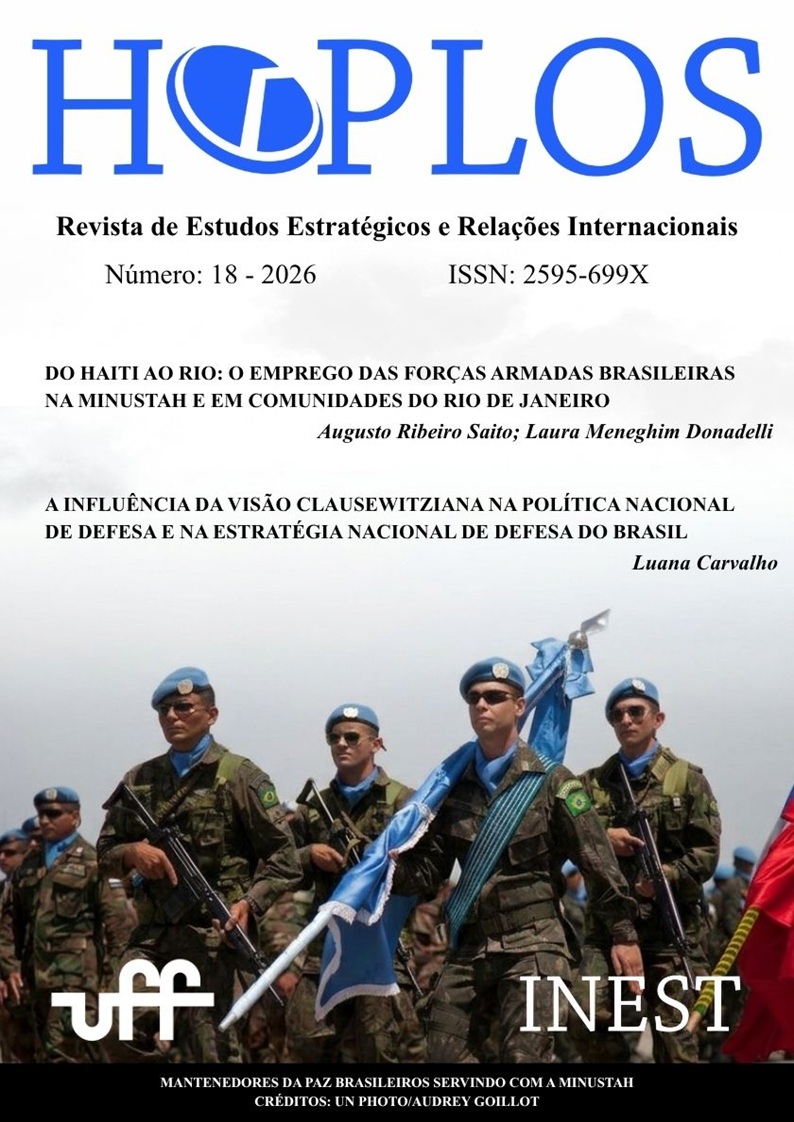
  1. From Haiti to Rio: The Deployment of the Brazilian Armed Forces in Minustah and in Rio de Janeiro’s Communities

    This paper analyzes the role of the Brazilian Armed Forces in the military command of the United Nations Mission for the Stabilization of Haiti (MINUSTAH), between 2004 and 2017, as well as in the Garantia da Lei e da Ordemoperations (GLO) — “O Rio quersegurança e paz” — and the Federal Intervention in Rio de Janeiro (2017-2018), both carried out under the aegis of the 1988 Federal Constitution. The objective is to compare the different types of military engagement in international and domestic contexts, highlighting the legacy of the experience in Haiti for the actions conducted in Rio de Janeiro's communities. As a primary source, the reports of the Observatório Sul-Americano de Defesa e Forças Armadas will be used, allowing the construction of a chronology of events with emphasis on motivations, training, rules of engagement, and the processes through which the operations were initiated and concluded. The analysis will be complemented by a literature review focused on international security, with particular attention to authors who address the militarization of public security. The findings reveal the strategies and resources employed by the Armed Forces in both contexts, as well as the effects of militarization at national and international levels. Additionally, the study highlights the international recognition obtained by Brazil as a result of its performance in these missions

  2. A GUERRA A SERVIÇO DO CAPITAL: UMA ATUALIZAÇÃO NA PERSPECTIVA DOS CONFLITOS NEOLIBERAIS

    Faced with the current expansion of predatory policies of neoliberalism, resulting from the financialization of the international system, we interpret war as a historical-social phenomenon at the service of capital. The so-called “war on drugs” in Latin America is an example of this perspective, since the implementation of its bureaucratic-repressive apparatus in state policies conditions marginalized territories and populations to a state of permanent war. In this article, we develop the concepts brought by classic works by contemporary authors such as Achille Mbembe, Grégoire Chamayou and Éric Alliez and Maurizio Lazzarato to reflect on the new forms of conflict arising from neoliberalism and present the cases of Peru and Rio de Janeiro (Brazil). We argue that the power of transnational capital generates the economic and social destabilization of marginalized communities, as observed in the case of Peru, and the normalization of the state of emergency based on constant military and police repression in urban peripheries, such as the favelas of Rio de Janeiro.

  3. The Influence of the Clausewitzian Vision on Brazil's National Defense Policy and National Defense Strategy

    This article aims to analyze the influence of the Clausewitzian perspective in Strategic Studies on the formulation of Brazil’s National Defense Policy (PND) and National Defense Strategy (END), based on the most recent versions published in 2024. The main objective is to understand whether the classical concepts developed by Carl von Clausewitz that influenced the emergence of Strategic Studies are present in the political and strategic thinking of the Brazilian state. Among them are the primacy of politics, the paradoxical trinity, the notion of friction, and the relationship between means and ends. The research uses a qualitative, exploratory approach based on a documentary analysis of the official texts of the PND and END, articulated with a literature review of central authors in Strategic Studies. The initial results show that the Clausewitzian view still exerts influence on the structure of Brazilian defense policies; however, some limits are identified, mainly regarding the emergence of new threats and instruments of international cooperation, such as diplomacy, cybersecurity, and the fight against transnational crime. Finally, the importance of establishing a dialogue between classical perspectives and contemporary demands is emphasized.

  4. A DIALÉTICA DA GUERRA NO SÉCULO NUCLEAR: CLAUSEWITZ E OS DESAFIOS DA ANIQUILAÇÃO

    This article explores the relevance of Carl von Clausewitz’s theory in the context of contemporary nuclear warfare, analyzing how the concepts of friction, chance, and the duality of war apply to the strategic landscape of the 21st century. The research is guided by a central question: to what extent are Clausewitz’s theories, originally developed for conventional conflicts, still applicable to the analysis of modern nuclear war, with a particular focus on nuclear powers? The methodology employed is based on a comprehensive qualitative review of the literature, encompassing both Clausewitz’s classical works and contemporary studies on nuclear strategy and deterrence. Among the key sources are traditional interpretations of Clausewitz, such as On War (1984), and modern works addressing the evolution of nuclear strategy, including Lawrence Freedman’s studies on deterrence (2004) and Paul Bracken’s analysis of the new nuclear era (2013). These works provide the theoretical foundation to compare Clausewitz’s theories with current strategic challenges, such as the logic of mutually assured destruction. The findings indicate that, despite the transformations brought about by nuclear weapons, Clausewitz’s fundamental concepts remain relevant to understanding the dynamics of nuclear warfare. The concept of "real war" versus "absolute war" remains pertinent in the analysis of nuclear deterrence strategies, demonstrating how the threat of total destruction shapes both conflict and policy. Furthermore, the study reveals that friction and chance, central elements in Clausewitz’s theory, play a crucial role in the nuclear era, where uncertainty and the speed of decision-making can have severe consequences. It is concluded that Clausewitz’s theoretical framework remains useful for analyzing nuclear war, offering a robust conceptual structure to address the complexities of the contemporary global strategic landscape.